
Gold has been used as a store of value for thousands of years, and it remains an important asset for investors today. For beginners, gold investment can be a way to diversify a portfolio, protect purchasing power, and gain exposure to an asset that behaves differently from stocks and bonds.
But investing in gold is not as simple as buying a gold coin and waiting for the price to rise. Investors in the United States can choose from several options, including physical gold, gold exchange-traded funds (ETFs), gold mining stocks, futures, and gold individual retirement accounts (IRAs). Each option has different costs, risks, liquidity, and tax considerations.
This gold investment for beginners guide explains how gold investing works, the different ways to invest in gold, the benefits and risks, and important factors to consider before making an investment.
What Is Gold Investment?
Gold investment means purchasing gold or an investment linked to the price or performance of gold with the expectation that it can preserve or increase your wealth over time.
Unlike a company stock, gold does not generate earnings or pay dividends. Its value is primarily influenced by supply and demand, investor sentiment, interest rates, inflation expectations, currency movements, central-bank activity, and broader economic conditions.
For US investors, gold can be held directly as physical bullion or indirectly through financial products such as gold ETFs and mining companies.
The main goal of investing in gold is often portfolio diversification. Instead of keeping all your money in stocks, bonds, or cash, you can potentially allocate a portion of your portfolio to another asset class.
Gold Investment Return Calculator
Why Do People Invest in Gold?
There are several reasons investors consider gold as part of a diversified portfolio.
1. Portfolio Diversification
One of the most common reasons to invest in gold is diversification.
Stocks and bonds can be affected by corporate earnings, economic growth, interest rates, and financial-market conditions. Gold has different supply-and-demand drivers, so its price can sometimes move differently from traditional investments.
Diversification does not eliminate investment risk, but holding different types of assets may help reduce dependence on the performance of a single market.
2. Potential Inflation Hedge
Gold is often described as an inflation hedge because investors have historically viewed it as a store of value when the purchasing power of currencies declines.
However, gold does not automatically rise whenever inflation increases. Its price can also be influenced by interest rates, real yields, the US dollar, investor demand, and other factors.
Therefore, beginners should think of gold as one potential component of a diversified strategy rather than a guaranteed protection against inflation.
3. Store of Value
Gold has maintained monetary and cultural importance across many generations.
Physical gold does not depend on the financial health of a particular company. A gold bar or coin represents a tangible asset, which is one reason some investors prefer physical gold.
4. Safe-Haven Demand
During periods of financial-market uncertainty, investors sometimes increase their exposure to assets considered defensive or safe-haven investments.
Gold can attract this type of demand during periods of economic uncertainty, market volatility, geopolitical concerns, or financial stress.
However, gold prices can also decline, so calling gold a “safe” investment should not be interpreted as meaning it is risk-free.
How to Invest in Gold in the USA
US investors have several ways to gain exposure to gold. The right option depends on your investment goals, time horizon, risk tolerance, liquidity requirements, and preference for physical ownership.
1. Physical Gold
The most direct approach is buying physical gold.
Examples include:
- Gold bars
- Gold bullion coins
- Gold rounds
- Certain investment-grade gold products
Popular bullion coins include products issued by government mints, while gold bars are available in different weights.
The advantage of physical gold is direct ownership. You own the metal rather than a financial security that tracks its price.
However, physical gold comes with additional considerations, including dealer premiums, storage, insurance, transportation, and the possibility of buying and selling at different prices.
Before buying, compare the spot price of gold with the dealer’s selling price. The difference is commonly referred to as the premium.
2. Gold ETFs
A gold ETF can provide exposure to gold without requiring you to personally store physical bullion.
Gold ETFs are traded through brokerage accounts in a similar way to stocks. Depending on the fund structure, the ETF may hold physical gold or provide exposure through other mechanisms.
For many beginners, gold ETFs can be easier to buy and sell than physical gold.
Before investing, review:
- Expense ratio
- Fund structure
- Tracking method
- Liquidity
- Assets under management
- Trading spread
- Tax considerations
A gold ETF can be particularly useful for investors who want market exposure without dealing with physical storage.
3. Gold Mining Stocks
Another option is investing in companies that explore for, produce, or process gold.
Gold mining stocks are not the same as owning gold.
A mining company can be affected by:
- Gold prices
- Production costs
- Energy prices
- Labor costs
- Management decisions
- Debt
- Political risks
- Mine production
- Operational problems
Because of these additional factors, a gold mining stock can rise or fall much more than the price of gold itself.
4. Gold Mutual Funds
Some mutual funds invest in gold mining companies or other precious-metals-related investments.
Before purchasing a fund, examine its holdings, management fees, historical performance, investment strategy, and risk profile.
A fund that invests in mining companies may behave differently from a fund that directly tracks gold.
5. Gold Futures
Gold futures allow investors to speculate on future gold prices using contracts traded on regulated markets.
However, futures can involve leverage and substantial risk. A relatively small movement in the price of gold can produce a much larger gain or loss relative to the amount of capital committed.
For this reason, gold futures are generally more complex than traditional gold investments and may not be appropriate for beginners.
6. Gold IRAs
A gold IRA is a type of self-directed individual retirement arrangement that can hold certain precious metals that meet applicable requirements.
Gold IRA investing can be more complicated than buying a regular gold ETF because investors need to consider custodians, storage requirements, fees, eligible metals, and tax rules.
Anyone considering a gold IRA should understand the applicable IRS requirements and carefully investigate fees and providers before moving money from an existing retirement account.
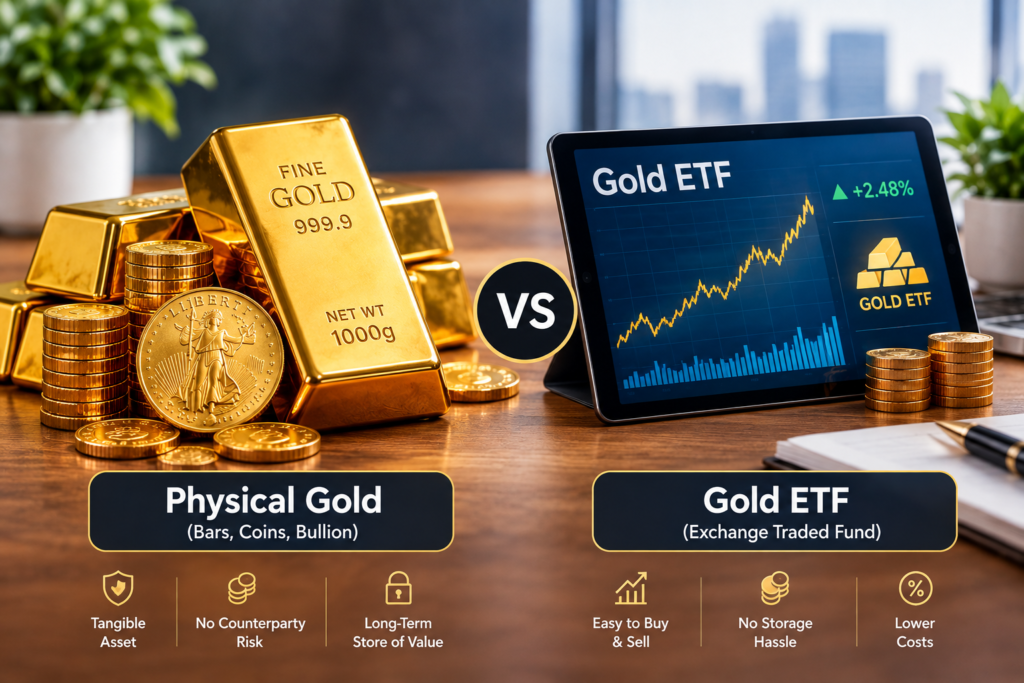
Physical Gold vs. Gold ETF
One of the most common questions from new investors is whether they should buy physical gold or a gold ETF.
Here is a simple comparison:
| Feature | Physical Gold | Gold ETF |
|---|---|---|
| Direct ownership | Yes | Generally no direct personal possession |
| Storage required | Yes | No personal storage |
| Easy to trade | Moderate | Generally easy during market hours |
| Dealer premium | Usually | Brokerage/trading costs may apply |
| Physical possession | Yes | No |
| Portfolio integration | Less convenient | Generally convenient |
| Beginner-friendly | Depends on preference | Often simpler |
Physical gold may appeal to investors who specifically want tangible ownership. A gold ETF may appeal to investors who prioritize convenience, liquidity, and easy portfolio management.
There is no single option that is appropriate for every investor.
Is Gold a Good Investment for Beginners?
Whether gold is a suitable investment depends on your financial objectives and overall portfolio.
Gold can provide diversification and exposure to a different asset class, but it also has limitations.
Unlike dividend-paying stocks, gold does not produce regular income. Unlike a bond, it does not make scheduled interest payments.
Your return generally depends on changes in the market value of gold or the investment linked to gold.
Before investing, consider:
- Your investment time horizon
- Your financial goals
- Your emergency savings
- Your existing investments
- Your risk tolerance
- Investment fees
- Liquidity requirements
A beginner should also avoid investing money needed for near-term expenses into a volatile asset.
How Much Gold Should a Beginner Own?
There is no universal percentage that every investor should allocate to gold.
Your allocation can depend on your overall financial situation, investment strategy, risk tolerance, and other assets.
Instead of asking, “What percentage should everyone invest in gold?” consider asking:
What role do I want gold to play in my portfolio?
For example, an investor may view gold primarily as a diversification asset, while another investor may be more interested in physical ownership or long-term wealth preservation.
The important point is to avoid allowing a single investment to dominate your financial plan without considering diversification and risk.
What Affects the Price of Gold?
Understanding the gold market can help beginners understand why gold prices move.
Interest Rates
Interest rates can influence gold because gold does not pay interest.
When interest-bearing assets become more attractive, the opportunity cost of holding gold can increase.
Changes in expectations for US monetary policy can therefore influence gold prices.
The US Dollar
Gold is generally priced internationally in US dollars.
Changes in the value of the dollar can influence gold prices and international demand.
A stronger or weaker dollar is only one factor, however, and gold prices are affected by many other market forces.
Inflation
Inflation expectations can affect investor demand for gold.
Some investors purchase gold because they believe it can help preserve purchasing power over long periods.
However, gold’s relationship with inflation is not perfectly consistent over every period.
Treasury Yields
US Treasury yields are another important market variable.
When real yields rise, holding a non-yielding asset such as gold may become relatively less attractive. Changes in yields and expectations about future interest rates can therefore influence gold investment demand.
Central Bank Demand
Central banks around the world hold gold as part of their reserves.
Changes in central-bank gold purchases can affect global demand and investor sentiment.
Economic and Geopolitical Uncertainty
Periods of financial or geopolitical uncertainty can increase interest in gold as a potential safe-haven asset.
However, market reactions can vary depending on the circumstances.
Gold Investment Risks Beginners Should Understand
Gold investing has potential benefits, but it also involves risks.
Gold Prices Can Fall
Gold is not guaranteed to increase in value.
An investor who buys gold at a high price can experience losses if the market price subsequently declines.
No Regular Income
Gold does not generate dividends or interest.
This makes it different from many stocks, bonds, and income-producing assets.
Physical Gold Has Additional Costs
Physical gold can involve:
- Dealer premiums
- Storage costs
- Insurance
- Shipping
- Selling spreads
These costs can reduce your effective return.
Gold Mining Stocks Have Company Risk
Buying a gold mining company exposes you to business and operational risks that do not exist in the same way when simply owning gold.
Fraud and Counterfeit Risk
Physical precious metals require careful purchasing.
Beginners should research dealers, verify products, understand pricing, and avoid offers that promise unrealistic returns.

A simple approach can help new investors avoid unnecessary complexity.
Step 1: Define Your Goal
Decide why you want gold exposure.
Is the goal diversification, long-term wealth preservation, retirement planning, or simply gaining exposure to the gold market?
Step 2: Choose Your Investment Type
Compare physical gold, gold ETFs, mining stocks, mutual funds, and other options.
Choose based on how much complexity and risk you are comfortable managing.
Step 3: Understand the Costs
Don’t focus only on the gold price.
Consider:
- Trading costs
- ETF expense ratios
- Dealer premiums
- Storage fees
- Insurance
- Account fees
- Tax implications
Step 4: Consider Your Time Horizon
Gold can experience significant price movements.
Think about whether you are investing for several months, several years, or a much longer period.
Step 5: Diversify
Gold should be considered within the context of your entire investment portfolio.
Diversification across different asset classes can help reduce concentration risk.
Step 6: Review Your Investment Periodically
Market conditions and personal financial circumstances change.
Review your portfolio periodically rather than making decisions solely based on short-term gold-price movements.
Gold Investment vs. Gold Mining Stocks
These two investments are often confused.
With gold, your investment is primarily linked to the price of the metal.
With a gold mining company, you are investing in a business.
A mining company may benefit when gold prices rise, but its share price can also be affected by production costs, management, debt, mine output, labor costs, and other business factors.
Therefore, gold mining stocks should not automatically be treated as a substitute for physical gold or a gold ETF.
Common Gold Investment Mistakes Beginners Make
Buying Because of Fear
Investing based entirely on fear of inflation, recession, or financial-market crashes can lead to emotional decisions.
Ignoring Fees
Small costs can have a meaningful impact on long-term returns.
Always understand the total cost before purchasing.
Putting Too Much Money Into Gold
Diversification works in both directions. Concentrating too much of a portfolio in one asset can increase risk.
Confusing Gold With Gold Stocks
Gold and gold mining companies have different risk profiles.
Chasing Short-Term Price Movements
Trying to predict every movement in gold prices is difficult.
A long-term investment plan can help reduce emotional decision-making.
Gold Investment for Retirement
Gold can also appear in retirement-planning discussions.
Some investors consider gold ETFs within brokerage or retirement accounts, while others explore precious-metals IRAs.
The key is understanding the rules, costs, investment options, and tax treatment before moving retirement money.
If you are considering a gold IRA rollover, carefully review the fees and requirements and consult a qualified financial or tax professional when appropriate.
Frequently Asked Questions About Gold Investment
Is gold a good investment for beginners?
Gold can be one option for investors seeking diversification, but it is not suitable for every portfolio. Beginners should understand its risks, costs, lack of regular income, and price volatility before investing.
What is the easiest way to invest in gold?
For many investors, a gold ETF can be simpler than purchasing, storing, and insuring physical gold. However, the appropriate choice depends on your objectives and preferences.
Should beginners buy physical gold?
Physical gold may be suitable for investors who specifically want direct ownership of bullion. Beginners should understand dealer premiums, storage, insurance, and selling costs before purchasing.
Is a gold ETF better than physical gold?
They serve different purposes. A gold ETF can offer convenience and liquidity, while physical gold provides direct possession of the metal. Compare their costs, risks, and practical benefits based on your investment goals.
Can gold protect against inflation?
Gold is often used as an inflation hedge, but it does not rise automatically whenever inflation increases. Interest rates, real yields, the US dollar, investment demand, and other factors also influence its price.
How much money should a beginner invest in gold?
There is no universal amount or allocation that applies to everyone. Consider your financial goals, risk tolerance, existing portfolio, emergency savings, and investment horizon before deciding.
Final Thoughts on Gold Investment for Beginners
Gold investment for beginners does not have to be complicated. The first step is understanding that gold is one asset class among many, not a guaranteed path to profit.
US investors can gain gold exposure through physical bullion, gold ETFs, mining stocks, mutual funds, futures, and certain retirement-account structures. Each approach has different benefits, costs, risks, and tax considerations.
Before investing, define your goal, compare the available options, understand all associated costs, and consider how gold fits into your broader portfolio.
Most importantly, avoid making investment decisions solely because gold prices are rising or because of short-term market headlines. A well-understood investment strategy should take into account your financial objectives, time horizon, risk tolerance, and overall diversification.
For beginners, learning how the gold market works may be more valuable than trying to predict the next gold-price move.