The Ultimate Guide to Your Debt-to-Income (DTI) Ratio: How to Calculate, Optimize, and Improve Your Borrowing Power
Whether you are planning to purchase your dream home, buy a new car, or secure a personal loan, lenders look at one metric above almost all others: your Debt-to-Income (DTI) ratio. This single percentage is the master key to your borrowing capacity, determining not only if you qualify for a loan, but also the interest rates you will pay.
What is the Debt-to-Income (DTI) Ratio?
At its core, the Debt-to-Income (DTI) ratio is a personal finance metric that compares your total monthly debt obligations to your gross monthly income. Expressed as a percentage, it tells financial institutions how much of your income is already spoken for before you take on new financial obligations.
Lenders use this ratio to measure your ability to manage monthly payments and repay borrowed money. A lower DTI ratio indicates a healthy balance between debt and income, signaling to lenders that you are a low-risk borrower. Conversely, a high DTI ratio suggests that you are overextended, meaning that any unexpected financial hiccup—such as medical expenses or job loss—could make it difficult for you to make your loan payments.
Front-End DTI vs. Back-End DTI: Understanding the Difference
When you apply for a mortgage, underwriters analyze two distinct variations of your DTI ratio. Understanding the difference is crucial, as a bottleneck in either ratio can stall your loan approval.
1. Front-End Ratio (Housing-to-Income Ratio)
The front-end ratio focuses solely on your prospective housing costs. It measures what percentage of your gross monthly income will go toward keeping a roof over your head. This calculation typically includes:
- Principal loan payment
- Interest on the mortgage
- Property Taxes
- Homeowners Insurance
- Homeowners Association (HOA) fees (if applicable)
- Private Mortgage Insurance (PMI) (if applicable)
This collective bundle of housing costs is often abbreviated as PITI.
2. Back-End Ratio (Total Debt-to-Income Ratio)
The back-end ratio is a more comprehensive assessment of your financial health. It measures the percentage of your gross monthly income required to cover all recurring monthly debt payments. This includes your prospective housing costs (PITI) plus all other monthly debts like student loans, credit card minimums, auto loans, and personal loans.
Note: Lenders pay the closest attention to the back-end ratio because it reflects your true, holistic financial obligations.
| Metric | Front-End Ratio (Housing) | Back-End Ratio (Total Debt) |
|---|---|---|
| What it Measures | Percentage of income spent on housing costs (PITI) only. | Percentage of income spent on housing costs PLUS all other monthly debts. |
| Typical Benchmark Limit | Normally capped at 28% (under the 28/36 rule). | Ideally capped at 36% (can go higher for specific loan programs). |
| What is Included | Mortgage principal, interest, taxes, home insurance, HOA fees. | All Front-End costs + credit card minimums, car loans, student loans, child support. |
How to Calculate Your Debt-to-Income Ratio
Calculating your DTI ratio manually is relatively straightforward, provided you gather the correct inputs. Let us break down the mathematical formulas used by our DTI calculator.
The General DTI Formula
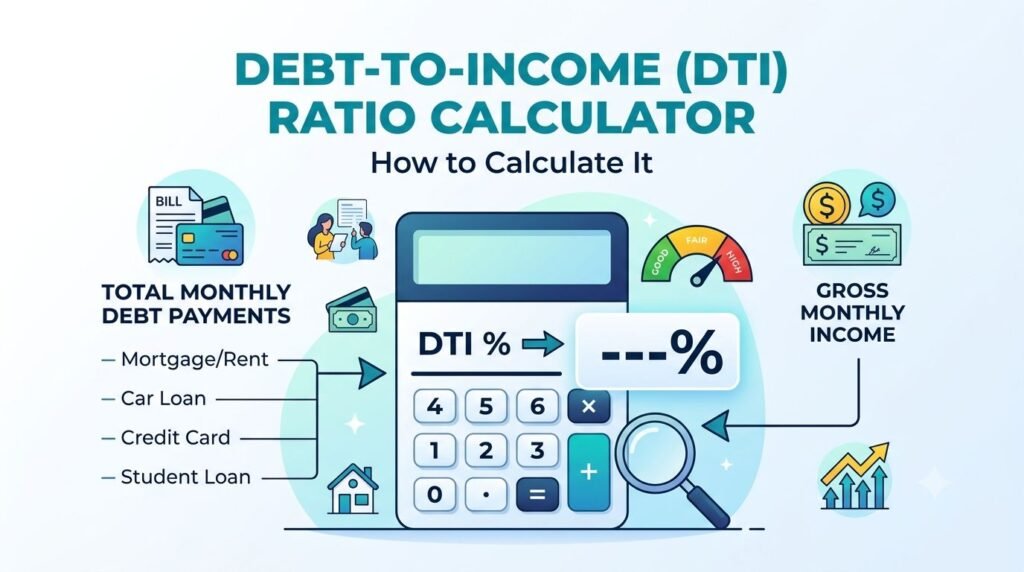
To calculate your back-end DTI ratio, use the following formula:
Step 1: Calculate Your Gross Monthly Income
Your Gross Monthly Income is the total amount of money you earn before taxes, health insurance premiums, or retirement contributions are deducted. It is not your “take-home pay.”
- For Hourly Workers: (Hourly Wage × Hours Worked Per Week × 52 weeks) ÷ 12 months
- For Salaried Workers: Annual Salary ÷ 12 months
- For Self-Employed/Freelancers: Use your net business income (historically averaged over 2 years) as reported on your tax returns.
You can also include verified, consistent secondary income sources, such as:
- Overtime and quarterly/annual bonuses (with a steady 2-year history)
- Alimony or child support payments received
- Social Security benefits or pension payouts
- Rental property income
- Investment dividends
Step 2: Add Up Your Recurring Monthly Debts
Only certain types of liabilities should be included in your monthly debt total. A common mistake is to lump every monthly expense into this category.
| Included in DTI (Recurring Debt) | Excluded from DTI (Living Expenses) |
|---|---|
|
|
Practical Examples of DTI Calculations
Let us look at two real-world examples to visualize how these numbers translate to a raw percentage.
Example 1: Sarah, the Aspiring Homebuyer
Sarah is looking to buy her first home and wants to see if her debt load is within reasonable parameters before contacting a mortgage broker.
- Gross Monthly Income: $6,500
- Car Loan Payment: $350
- Student Loan Payment: $200
- Credit Card Minimums: $150
- Estimated Future Housing Cost (PITI): $1,800
Let us perform the calculations:
- Total Non-Housing Debt: $350 + $200 + $150 = $700
- Total Future Debt (including housing): $700 + $1,800 = $2,500
Now, calculate her ratios:
- Front-End DTI: ($1,800 ÷ $6,500) × 100 = 27.69%
- Back-End DTI: ($2,500 ÷ $6,500) × 100 = 38.46%
Verdict: Sarah is in a strong financial position. Her front-end ratio is just under the 28% limit, and her back-end ratio is highly competitive, making her an excellent candidate for a conventional home loan.
Example 2: Marcus, looking for a Debt Consolidation Loan
Marcus wants to secure a personal loan to consolidate his high-interest credit card debt. He wants to see if he qualifies.
- Gross Monthly Income: $4,000
- Rent Payment: $1,200
- Credit Card Minimums: $600
- Car Loan Payment: $300
Let us perform the calculations:
- Total Monthly Debt: $1,200 + $600 + $300 = $2,100
Calculate his ratio:
- Back-End DTI: ($2,100 ÷ $4,000) × 100 = 52.5%
Verdict: Marcus has a DTI of over 50%. Most traditional lenders will view Marcus as a high-risk borrower. He will need to focus on paying down his balances or increasing his earnings before he can easily qualify for favorable loan terms.
What is a “Good” Debt-to-Income Ratio?
The standard thresholds of what constitutes an acceptable DTI ratio vary by lender and loan product. However, the general consensus across the personal finance and banking industries is categorized as follows:
- Under 36% (Excellent): You have a healthy cushion between your income and debt obligations. You will qualify for the best loans, credit cards, and interest rates.
- 36% to 43% (Good/Acceptable): This is a standard bracket. Most lenders will still approve you, though they may require a strong credit score, substantial cash reserves, or a larger down payment.
- 44% to 49% (Moderate/Concerning): You are approaching critical limits. You may face obstacles qualifying for conventional loans. You might be limited to specialized loan programs (such as FHA) or have to pay higher interest rates.
- 50% or higher (High Risk): Over half of your income goes directly to debt obligations. It will be incredibly difficult to borrow money from standard institutions. You will likely be rejected or face predatory interest rates from subprime lenders.
DTI Requirements Across Different Loan Programs
If you are applying for a home mortgage, different loan categories carry strict statutory limits on your debt-to-income ratios. Our calculator can help you evaluate your standing for each program:
- Conventional Loans: Typically adhere to the 28/36 rule. Under certain automated underwriting guidelines, conventional loans can allow back-end ratios up to 45% (or 50% with strong compensating factors like excellent credit scores or significant cash reserves).
- FHA Loans (Federal Housing Administration): FHA loans are designed for first-time home buyers and individuals with moderate income or lower credit scores. The typical limit is 31/43, but they are incredibly flexible. With automated approval and strong compensating factors, FHA limits can stretch up to 50% or more.
- VA Loans (Veterans Affairs): Designed for active-duty military, veterans, and surviving spouses. VA loans do not have a hard front-end ceiling. They use a benchmark of 41% for the back-end ratio, though they primarily emphasize “residual income” (how much money you have left over for daily living after all debts are paid).
- USDA Loans (US Department of Agriculture): Aimed at low-to-moderate-income families purchasing in rural designated areas. The typical DTI requirements are strict, capping ratios at 29/41. However, exceptions can be made with higher credit scores.
How to Use the Online DTI Ratio Calculator
Our online Debt-to-Income (DTI) Ratio Calculator eliminates manual math, spreadsheet setups, and the potential for computational errors. To get an accurate reading on your debt load, simply follow these basic steps:
- Input Your Gross Monthly Income: Enter your monthly pretax salary. If you have secondary streams (dividends, alimony, side hustles), add those to this field as well.
- Input Your Housing Costs: Enter your prospective or current rent/mortgage payment, including property taxes, home insurance, and HOA fees.
- Input Your Monthly Debt Obligations: Enter your auto loans, student loans, credit card minimums, and any personal loans. Do not include standard living expenses like utility bills, grocery costs, or phone bills.
- Click Calculate: The tool will instantly calculate your Front-End DTI, your Back-End DTI, and show you exactly where you fall on the financial health scale.
Common Mistakes to Avoid When Calculating Your DTI
A minor error in your DTI inputs can lead to a false sense of security or undue panic. Keep these pitfalls in mind:
- Confusing Net Income with Gross Income: Always calculate based on pre-tax earnings (gross). If you use your net income (take-home pay), your DTI ratio will appear artificially high, making you look worse off than you actually are.
- Including Non-Debt Monthly Bills: Do not include utilities, car insurance, subscriptions, or food in your calculations. While they are monthly financial commitments, they are not classified as recurring debt agreements.
- Excluding Co-signed Loans: If you co-signed a car loan for your child or a student loan for a relative, that liability technically belongs to you. Unless you can prove with 12 months of consecutive bank statements that the other party has been paying on time, lenders will count that full payment against your DTI.
- Underestimating Credit Card Payments: Lenders do not look at how much you choose to pay on your credit card each month (unless you pay the balance in full every single month). Instead, they look at your minimum required payment listed on your credit report. If you have zero balance, use $0.
- Ignoring Variable Income Guidelines: Do not count bonus or commission income unless you have received it reliably for at least two consecutive years and can prove it is highly likely to continue.
Proven Strategies to Lower Your Debt-to-Income Ratio
If your calculator results show a DTI that is higher than you would like, do not panic. It is not a permanent status. There are two levers you can adjust to alter this equation: lowering your debt or increasing your income.
1. Attack Your Monthly Debts (The Outflow)
- Pay Off Small Balances First (Debt Snowball Method): Focus on paying off loans with low balances but high monthly payments. Even if the interest rate is lower, wiping out a $400 car loan payment or a $100 store credit card payment immediately drops your numerator in the DTI equation, lowering your overall ratio.
- Consolidate and Refinance: If you have high-interest credit card debt, taking out a low-interest debt consolidation loan can reduce your total monthly minimum payments, thus reducing your DTI. If interest rates have dropped, refinancing your auto loan can also free up critical breathing room.
- Avoid New Credit Applications: Do not finance a new car, purchase furniture on a financing plan, or open new retail credit cards in the months leading up to a mortgage application.
2. Elevate Your Monthly Earnings (The Inflow)
- Ask for a Raise: If you are due for an annual review, present your achievements to your employer. A $5,000 annual raise increases your gross monthly income by over $416, which immediately reduces your DTI.
- Pick Up Verified Side Work: If you have a secondary job or freelance hustle, ensure you document the earnings thoroughly on your tax returns. This guarantees you can legally include those earnings on your next loan application.
Frequently Asked Questions (FAQs)
Does a high DTI ratio directly damage my credit score?
No. Your DTI ratio is not included on your credit report, and credit scoring bureaus (like FICO or VantageScore) do not use it to calculate your credit score. However, a high DTI often correlates with high credit utilization (the percentage of your credit limits you are using), which does directly affect your credit score.
Will paying off credit cards in full every month lower my DTI?
Yes. If your credit cards show a $0 balance when the lender pulls your credit report, your minimum monthly payment will be $0. This completely eliminates credit card debt from your DTI calculation.
Can I get a mortgage with a DTI ratio of 50%?
It is difficult, but not impossible. Certain Government-Backed loans (such as FHA or VA) can approve borrowers with DTIs up to 50% or slightly higher if they have compensating factors. These include excellent credit scores (720+), significant cash reserves, stable employment history, or a large down payment.
Do student loans in deferment or forbearance count toward my DTI?
Yes. Even if your student loans are temporarily paused, lenders will still calculate a monthly payment for DTI purposes. Typically, lenders will use either 0.5% or 1% of your total outstanding loan balance as a proxy monthly payment to ensure they are accounting for future risk.
Does rent count in your DTI ratio when buying a home?
No. When you apply for a home loan, your current rent payment is omitted from the back-end DTI. It is replaced by your estimated prospective housing payment (PITI) for the home you are looking to purchase.
Why did my lender calculate a different DTI than I did?
This is common. Lenders may calculate your income differently, especially if you receive commissions, bonuses, or are self-employed. They also rely strictly on the monthly debt payments listed on your credit report, which may lag by 30 to 60 days compared to your real-time accounts.
Take Control of Your Financial Future Today
Before you fill out a formal loan application or meet with a loan officer, it pays to know exactly where you stand. Knowing your debt-to-income ratio puts the power back in your hands, giving you the runway to adjust your finances, negotiate better terms, and borrow with total confidence.
Use our free Debt-to-Income (DTI) Ratio Calculator now to get an instant, accurate picture of your financial profile. Clear path, calculated decisions, smarter borrowing!