The Ultimate Guide to Mortgage Extra Payments: How to Save Thousands and Retire Debt-Free
For the vast majority of homeowners, a mortgage is the single largest financial commitment of their lifetime. Standard home loans are structured around a 15-year or 30-year repayment schedule, which can feel like a lifelong anchor weighing down your financial freedom. Over these long durations, the total interest paid to the lender can easily equal or even exceed the original amount borrowed. However, you do not have to remain locked into this expensive timeline.
By using a Mortgage Extra Payment Calculator, you can take control of your financial destiny. Making additional payments toward your loan principal—even modest ones—can dramatically shorten your loan term and shave tens of thousands of dollars off your total interest bill. This comprehensive guide will break down the mechanics of amortization, explain the mathematical formulas behind extra payments, outline the most effective prepayment strategies, highlight common mistakes to avoid, and provide a step-by-step roadmap for utilizing our free online calculator to achieve your debt-free goals.
Understanding the Mechanics of Mortgage Amortization
To appreciate how extra payments work, it is essential to understand how a standard mortgage amortizes. Amortization is the process of spreading out a loan into a series of equal, periodic payments. While your monthly payment remains constant (assuming a fixed-rate mortgage), the internal allocation of that payment changes every single month.
The Principal vs. Interest Balance
Every standard mortgage payment is split into two primary components:
- Principal: The money that directly reduces the outstanding balance of your loan.
- Interest: The fee charged by the lender for borrowing the money, calculated as a percentage of your remaining principal balance.
In the early years of a mortgage, your outstanding balance is at its highest. Because interest is calculated based on this large balance, the vast majority of your monthly payment goes toward paying off interest, leaving only a small fraction to reduce the principal. As the years progress and the principal slowly decreases, the monthly interest charge also drops, allowing a larger portion of your fixed payment to be applied to the principal. This compounding effect accelerates toward the end of the loan term.
How Extra Payments Disrupt the Equation
When you make an extra payment and specify that it should be applied directly to the principal balance (known as “principal curtailment”), you bypass the amortization schedule. Here is what happens behind the scenes:
- Your outstanding principal balance instantly decreases by the amount of your extra payment.
- Because your principal is now lower, the interest charge for the following month is recalculated based on this smaller balance.
- Consequently, less of your next standard monthly payment is wasted on interest, and more of it is automatically directed toward your principal.
- This creates a powerful compounding snowball effect, pulling your payoff date closer and saving you money on interest every single month.
The Mathematics of Extra Mortgage Payments
To truly understand how a Mortgage Extra Payment Calculator operates, let’s look at the underlying mathematics. Do not worry—while the formulas might look complex at first, we will break them down into simple, digestible terms.
1. The Standard Monthly Payment Formula
To calculate the baseline monthly payment ($M$) for a fixed-rate loan, lenders use the following amortization formula:
M = P × [ r(1 + r)^n ] / [ (1 + r)^n – 1 ]
Where:
- M: Total monthly principal and interest payment.
- P: Outstanding principal loan amount.
- r: Monthly interest rate (annual interest rate divided by 12 months).
- n: Total number of payments (loan term in years multiplied by 12).
2. The Compound Interest Formula for Savings
When you pay down your principal early, you are essentially “earning” a risk-free return equal to your mortgage interest rate. The interest saved ($I_{saved}$) on a specific extra payment ($E$) over a remaining period of $t$ years can be approximated using the compound interest model:
I_{saved} = E × [ (1 + r)^{12t} – 1 ]
This shows that an extra dollar paid today saves significantly more than a dollar paid ten years from now. Time is the most critical variable in maximizing interest savings.
A Concrete Hand-Calculated Example
Let’s walk through a simplified, real-world example to see how the numbers play out in real-time. Suppose you have the following mortgage profile:
- Loan Amount (P): $300,000
- Annual Interest Rate: 6% (or $r = 0.06 / 12 = 0.005$ monthly)
- Loan Term: 30 years ($n = 360$ months)
Using our standard formula, your base monthly payment (excluding taxes, insurance, and HOA fees) is:
M = $300,000 × [ 0.005(1.005)^{360} ] / [ (1.005)^{360} – 1 ] = $1,798.65
Now, let’s look at the allocation of your very first payment:
- Interest Portion: $300,000 × 0.005 = $1,500.00
- Principal Portion: $1,798.65 – $1,500.00 = $298.65
- Remaining Principal: $300,000 – $298.65 = $299,701.35
As you can see, 83.4% of your first payment goes straight into the lender’s pocket! Now, imagine that along with your very first payment, you make a one-time extra principal payment of $5,000.
- New Remaining Principal: $299,701.35 – $5,000 = $294,701.35
When month two arrives, the interest is calculated on this new, lower balance:
- Month 2 Interest (without extra payment): $299,701.35 × 0.005 = $1,498.51
- Month 2 Interest (with extra payment): $294,701.35 × 0.005 = $1,473.51
By making that single $5,000 extra payment, you save $25 in interest in the very first month. Over the course of the remaining 29 years and 11 months, that single action will compounding save you roughly $23,500 in total interest and shorten your mortgage term by several months. That is the incredible power of principal prepayment!
Prepayment Strategies: Finding Your Perfect Approach
There is no one-size-fits-all strategy for paying off a mortgage early. The best method depends on your monthly cash flow, financial discipline, and personal lifestyle. Below are the four most common prepaying methodologies supported by our calculator.
| Strategy | Description | Ease of Execution | Financial Impact |
|---|---|---|---|
| Additional Monthly Amount | Adding a fixed dollar amount to every single monthly mortgage payment. | High (Can be automated with your servicer) | Consistent, long-term savings |
| Bi-Weekly Payment Schedule | Paying half your monthly mortgage amount every two weeks instead of monthly. | Medium (Requires setting up bi-weekly payroll matching) | Equivalent to making 1 extra monthly payment per year |
| Annual Lump-Sum Prepayment | Making one large payment once a year using bonuses, tax refunds, or windfalls. | Low (Requires manual budgeting of windfalls) | High immediate reduction in principal |
| One-Time Major Prepayment | Making a single massive prepayment early in the loan term (e.g., from an inheritance or property sale). | Low (Occurs rarely) | Dramatically accelerates timeline and minimizes lifetime interest |
1. The Additional Monthly Amount Strategy
This is the most popular strategy due to its simplicity and consistency. By choosing to add an extra $100, $200, or $500 to your monthly payment, you build a predictable routine. It is easily automated through your lender’s online portal. Over time, as your income grows, you can gradually scale this monthly addition up.
2. The Bi-Weekly Payment Strategy
Because there are 52 weeks in a year, making a half-payment every two weeks results in 26 half-payments. This equates to 13 full monthly payments per year instead of the usual 12. Without feeling a major squeeze on your wallet, you automatically pay off an extra month’s worth of principal each year. For a 30-year mortgage, this simple shift can reduce your repayment timeline by roughly 4 to 6 years.
3. The Annual Lump-Sum Strategy
If your cash flow is tight on a month-to-month basis but you receive annual bonuses, commissions, or a tax refund, the annual lump-sum approach is ideal. Once a year, you apply a set amount (e.g., $3,000) directly to your principal. This keeps your monthly obligation low while still making a huge dent in your debt over the long run.
—
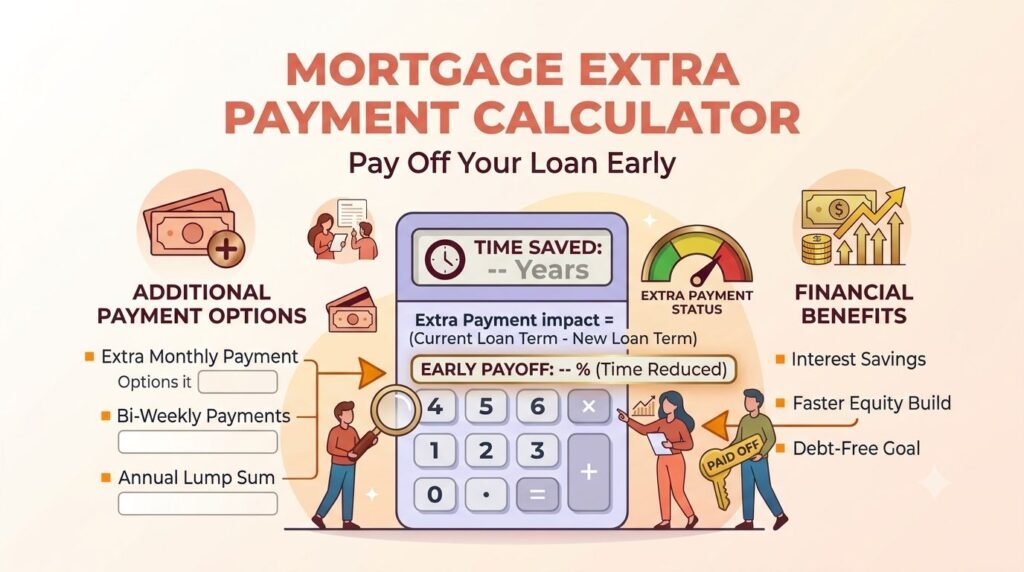
Step-by-Step: How to Use the Mortgage Extra Payment Calculator
Our free online calculator takes the guesswork out of your financial planning. Here is how you can use it to map out your payoff journey in under two minutes:
Step 1: Input Your Core Loan Details
- Original/Current Loan Amount: Enter the total outstanding balance of your mortgage.
- Interest Rate: Input your annual fixed interest rate (e.g., 6.5%).
- Remaining Loan Term: Specify how many years or months are remaining on your loan.
Step 2: Define Your Extra Payment Strategy
Our tool allows you to input three types of extra payments simultaneously or independently:
- Monthly Extra: Enter an amount you plan to add to every monthly payment.
- Yearly Extra: Enter an amount you plan to pay once a year (and select the month of payment).
- One-Time Extra: Enter a single, lump-sum payment amount and the specific month/year it will occur.
Step 3: Analyze the Results
Once you click “Calculate,” the tool instantly outputs three critical metrics:
- Total Interest Saved: The exact dollar amount you prevented the bank from collecting.
- Time Saved: The exact number of years and months you shaved off your loan term.
- New Payoff Date: The precise month and year you will become officially mortgage-free.
—
The Financial Trade-offs: Prepaying vs. Investing
While paying off a mortgage early is emotionally satisfying, it is crucial to analyze this decision through a cold, financial lens. Is prepaying always the smartest move? Let’s compare prepaying your mortgage to investing those same funds in the stock market.
The Concept of Opportunity Cost
When you allocate cash toward your mortgage principal, you lose the opportunity to invest that cash elsewhere. To make the correct decision, you must compare your mortgage interest rate against your expected rate of return on alternative investments.
- The Guaranteed Return of Debt Paydown: Paying down a mortgage with a 6.5% interest rate yields a guaranteed, tax-free return of 6.5%. You are guaranteed to save that interest expense.
- The Variable Return of Market Investing: Historically, the S&P 500 index has returned an average of 8% to 10% annually over long-term horizons. However, this return is not guaranteed, is subject to market volatility, and is taxable upon realization of gains.
The Rule of Thumb for Decision Making
To simplify this choice, assess your current mortgage rate environment:
- Low-Rate Environment (Under 4%): If you secured a historically low rate during the pandemic, you are likely better off investing your extra cash in the market or keeping it in high-yield savings accounts (HYSAs) earning 4% to 5%. In this case, you are mathematically arbitrage-profiting.
- High-Rate Environment (Over 6%): If your mortgage rate is 6% or higher, prepaying is an incredibly attractive option. Earning a guaranteed, tax-free 6%+ return by paying down your mortgage is extremely difficult to consistently beat in the stock market on a risk-adjusted basis.
—
Common Mistakes to Avoid When Making Extra Payments
Paying off a mortgage early seems straightforward, but minor mistakes can cost you money or void your efforts. Be sure to avoid these four common traps:
1. Not Specifying “Apply to Principal Only”
This is the most common and damaging mistake. If you simply write a check for more than your monthly payment or send extra money online without instructions, many mortgage servicers will automatically apply the excess to your next scheduled monthly payment (prepaying interest ahead of time). This does not reduce your outstanding principal or save you long-term interest.
Solution: Always check the option “Apply to Principal” in your online payment portal, or write “Apply extra payment to principal only” in the memo line of physical checks.
2. Ignoring Prepayment Penalties
While rare in modern conventional loans, some mortgage contracts include a prepayment penalty clause. Lenders make their money off interest; if you pay off the loan too fast, they may charge a penalty to recoup lost profits.
Solution: Read your closing disclosure documents or call your lender directly to confirm that your loan is free of prepayment penalties before accelerating your payoff.
3. Neglecting Your Emergency Fund
Once you pay extra money into your mortgage, that cash is locked up inside your home equity. If you face a sudden medical bill, job loss, or car repair, you cannot easily retrieve that cash without taking out an expensive home equity loan or refinancing.
Solution: Maintain a liquid emergency fund containing 3 to 6 months of living expenses in a separate high-yield savings account before you send a single extra dollar to your mortgage company.
4. Failing to Optimize High-Interest Debt First
While home loans are large, they usually carry far lower interest rates than consumer debt. Paying off a 6% mortgage while carrying a balance on a 22% interest rate credit card is a severe financial error.
Solution: Follow the debt snowball or avalanche method to eradicate all high-interest credit cards, personal loans, and auto loans before turning your attention to your mortgage.
—
In-Depth Case Studies
Let’s examine three detailed case studies to visualize the impact of extra payments across different loan sizes and interest rates.
Case Study 1: The Moderate Budgeter ($250,000 Loan at 6.0%)
Sarah has a $250,000 30-year fixed-rate mortgage with a 6.0% interest rate. Her standard monthly payment is $1,498.88.
- Standard Profile: Over 30 years, she will pay a staggering $289,595 in total interest.
- The Strategy: Sarah decides she can cut back on dining out and commit to an extra $150 per month toward her principal.
- The Result: By paying $1,648.88 each month, Sarah saves $61,124 in interest and pays off her home 5 years and 8 months early.
Case Study 2: The Aggressive Saver ($400,000 Loan at 7.5%)
David and Maria bought their home during a period of elevated interest rates. They have a $400,000 30-year loan at 7.5%. Their standard monthly payment is $2,796.86.
- Standard Profile: Over 30 years, they are scheduled to pay $606,870 in interest—far more than the home itself cost!
- The Strategy: They decide to pay an extra $500 per month from their joint income and apply their annual tax refund of $3,000 as an annual lump sum.
- The Result: Using the calculator, they find that this aggressive strategy saves them an astronomical $294,410 in interest and cuts their loan term nearly in half, paying off the home in just 16 years and 2 months!
Case Study 3: The Windfall Investor ($350,000 Loan at 5.5%)
James has a $350,000 mortgage at 5.5% with 25 years remaining. He inherits $40,000 and wants to know if he should pay down his mortgage or keep it in a standard investment account.
- The Strategy: James makes a one-time principal prepayment of $40,000 in Year 5.
- The Result: This single, early intervention reduces his mortgage term by 4 years and 1 month, saving him $72,850 in interest expenses over the life of the loan. This represents a guaranteed, risk-free return of 5.5% compounded annually on his inherited capital.
—
Frequently Asked Questions
Does paying extra on a mortgage lower the monthly payment?
No, making extra principal payments on a standard fixed-rate mortgage will not lower your subsequent monthly payments. Your monthly bill remains exactly the same. Instead, the extra payments shorten your overall loan term and reduce the total amount of interest you will pay over the life of the loan. If you want to lower your monthly payment, you must ask your lender about “re-amortizing” or “recasting” the loan, which recalculates your monthly payment based on the new, lower balance.
How often should I make extra payments?
The earlier you make an extra payment, the more interest you will save, as interest is calculated monthly. Therefore, adding a small amount to your monthly payment is mathematically superior to waiting until the end of the year to make a single lump-sum payment of the same total value. However, the best frequency is the one that fits your cash flow and budget structure seamlessly.
Should I pay off my mortgage early if I have a low interest rate?
Generally, if your mortgage interest rate is below 4%, it is mathematically wiser to keep extra funds in a high-yield savings account (which may yield 4.5% to 5.5% as of 2026) or invest them in diversified index funds. However, some homeowners prefer the psychological peace of mind of being completely debt-free, which carries a non-monetary value that should not be discounted.
Can I make extra payments on an FHA or VA loan?
Yes. FHA, VA, and conventional loans all allow for extra payments without prepayment penalties. However, keep in mind that with an FHA loan, paying down your principal early will not automatically remove your Mortgage Insurance Premium (MIP). To eliminate FHA MIP, you typically have to refinance the loan once you reach 20% equity, unless you put down 10% or more at the time of purchase.
What is the “13th Payment” trick?
The “13th Payment” trick is another term for the bi-weekly payment strategy or making one extra full monthly payment each year. By dividing your monthly principal and interest payment by 12 and adding that amount to your payment each month, you will successfully make 13 full payments over a 12-month calendar year, shortening a 30-year loan by roughly 4 to 5 years.
How does a loan recast differ from making extra payments?
When you make extra payments, your monthly payment remains unchanged, but your loan term decreases. In a mortgage recast, you make a large lump-sum principal payment (usually $5,000 or more), and the lender recalculates your amortization schedule using your new, lower balance over your *existing* remaining term. This lowers your monthly payment while keeping your final payoff date the same.
—
Actionable Tips to Maximize Your Mortgage Savings
Ready to start your journey toward home ownership freedom? Follow these actionable tips to maximize your success:
- Automate Your Savings: Treat your extra mortgage payment like any other utility bill. Set up an automatic recurring payment through your bank’s bill pay system so you do not have to think about it.
- Use Your “Found Money”: Commit to allocating 50% of every future pay raise, tax refund, or cash gift directly toward your mortgage principal. This prevents lifestyle inflation while accelerating your wealth building.
- Audit Your Statement: After your first month of making extra payments, check your online portal or monthly paper statement. Verify that your extra funds are categorized as a “Principal Curtailment” or “Principal Prepayment” and not as an “Advance Payment.”
- Recalculate Yearly: Life changes, and so does your cash flow. Revisit our Mortgage Extra Payment Calculator once a year to adjust your inputs based on salary changes, refinancing, or financial goals.
Take Control of Your Financial Future Today
The math is clear: waiting 30 years to pay off a home is an incredibly expensive proposition. By making strategic, deliberate extra principal payments, you can reclaim your financial independence, save tens of thousands of dollars in interest, and build real home equity at an accelerated rate.
Stop wondering “what if.” Use our interactive Mortgage Extra Payment Calculator right now. Plug in your current numbers, experiment with different payment strategies, and design a customized, high-impact plan that turns your dream of a debt-free life into reality.