Heart disease does not announce itself. Most people who suffer a heart attack or stroke had no idea their risk was building quietly, year after year, inside their arteries. The good news? A simple cholesterol risk calculator can give you an early, personalised picture of where you stand and whether it is time to make changes.
Our free cardiovascular risk calculator on AllCalculatorTools uses the clinically validated Pooled Cohort Equations (PCE), the same framework used by cardiologists worldwide to estimate your 10-year risk of a heart attack or stroke. Whether you are a man over 40 concerned about rising cholesterol levels, a woman wondering how menopause is affecting your heart health, or simply someone who just received a lipid profile report and wants to understand it better, this tool is built for you.
In this guide, we will explain what cholesterol really means, how the ASCVD risk score works, what your numbers tell you, and most importantly, what practical steps you can take to protect your heart.
What Is Cholesterol and Why Does It Matter?
Cholesterol is a waxy, fat-like substance found in every cell of your body. Despite its bad reputation, it is not inherently harmful. Your body needs cholesterol to produce hormones, vitamin D, and bile acids that help with digestion. The problem arises when certain types of cholesterol accumulate in the wrong places, namely, inside your artery walls.
Cholesterol travels through your bloodstream in small packages called lipoproteins. Your lipid profile report will typically show four key values: total cholesterol, LDL cholesterol, HDL cholesterol, and triglycerides. Each one tells a slightly different story about your cardiovascular health.
LDL Cholesterol: The ‘Bad’ Cholesterol
Low-density lipoprotein (LDL cholesterol) is often called bad cholesterol because high levels cause plaque to build up in your arteries. Over time, this narrows the arteries and restricts blood flow a condition known as atherosclerosis. If a plaque ruptures, it can trigger a blood clot that causes a heart attack or stroke. Most heart disease risk calculators place significant weight on LDL because it is the most direct driver of artery damage.
HDL Cholesterol: The ‘Good’ Cholesterol
High-density lipoprotein (HDL cholesterol) works in the opposite direction. It acts as a kind of clean-up crew, picking up excess cholesterol from your arteries and transporting it back to the liver for removal. Higher HDL levels are generally protective. A low HDL level, particularly below 40 mg/dL in men or 50 mg/dL in women, is a significant risk factor for cardiovascular disease.
Total Cholesterol and Triglycerides
Total cholesterol is the sum of all cholesterol types in your blood. Most guidelines consider a total cholesterol below 200 mg/dL desirable. Triglycerides are a type of fat found in your blood that your body uses for energy, but high triglyceride levels (above 150 mg/dL) combined with low HDL are closely linked to metabolic syndrome and heart disease risk. Together, these four values paint a comprehensive picture of your lipid profile.
How Does Our Cholesterol Risk Calculator Work?
Our heart disease risk calculator uses the Pooled Cohort Equations (PCE), which were developed and endorsed by the American College of Cardiology (ACC) and the American Heart Association (AHA). This is the gold standard cardiovascular risk calculator used in clinical practice to estimate an individual’s 10-year ASCVD (Atherosclerotic Cardiovascular Disease) risk, meaning the probability of experiencing a heart attack or stroke within the next decade.
The ASCVD risk calculator takes into account the following factors:
- Age (40–79 years) Risk increases naturally with age
- Gender: Men and women have different baseline risk profiles
- Race/Ethnicity Research shows different risk patterns across populations
- Total cholesterol and HDL cholesterol. The cholesterol level calculator uses your LDL HDL ratio indirectly
- Systolic blood pressure: Whether treated or untreated matters differently
- Diabetes status doubles cardiovascular risk in many patients
- Smoking status is one of the most modifiable risk factors
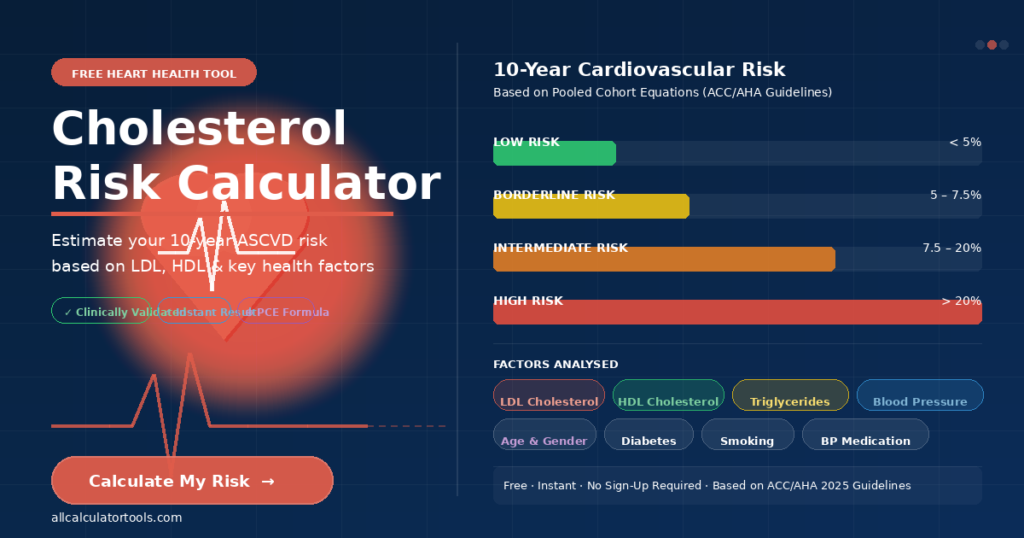
Simply enter your values, and the heart risk assessment calculator will instantly produce your estimated 10-year cardiovascular risk percentage, along with a risk category Low, Borderline, Intermediate, or High.
Understanding Your Cardiovascular Risk Score
Once you have used the cholesterol risk calculator by age and gender, your result falls into one of four categories. Here is what each one means:
Low Risk (Below 5%)
A 10-year ASCVD risk below 5% is reassuring. It means that, based on your current profile, fewer than 5 in 100 people like you would be expected to have a heart attack or stroke within the next decade. The focus here is on maintaining heart-healthy habits rather than medication.
Borderline Risk (5% to 7.5%)
This range is a warning sign worth discussing with your doctor. Additional factors like a family history of early heart disease, elevated C-reactive protein (CRP), or a coronary calcium score may push you into a higher category. Lifestyle changes are strongly recommended at this stage.
Intermediate Risk (7.5% to 20%)
An intermediate 10-year cardiovascular risk calculator result is where most treatment conversations begin. Depending on your full clinical picture, your doctor may recommend starting a statin, intensifying dietary changes, or further investigation.
High Risk (Above 20%)
A result above 20% indicates a significant likelihood of a cardiovascular event within the next 10 years. Medical intervention including statins, blood pressure medications, and significant lifestyle changes is typically recommended without delay. If you see this result, please consult a healthcare professional as soon as possible.
Cholesterol Risk by Age and Gender: What Changes Over Time?
One of the most important things our cholesterol risk calculator by age and gender reveals is that risk is not static it shifts significantly across different life stages.
Cholesterol Risk Calculator for Men Over 40
For men, cardiovascular risk typically begins rising meaningfully after age 40. Men tend to have naturally lower HDL cholesterol levels than women, which removes one of the key protective buffers. A cholesterol risk calculator for men over 40 often shows intermediate or high risk even with moderately elevated LDL, because the combination of age, lower HDL, and other lifestyle factors compounds over time. If you are a man in your 40s or 50s, this is an excellent time to get a baseline lipid profile and run your numbers.
Cholesterol Risk Calculator for Women
Women are often protected from heart disease by estrogen during their reproductive years but this changes dramatically after menopause. Post-menopausal women frequently see a rise in LDL cholesterol and a fall in HDL, which can cause their cardiovascular risk to catch up with or even exceed that of men of the same age. A cholesterol risk calculator for women is particularly important for those aged 55 and above. Women with conditions like polycystic ovary syndrome (PCOS) or a history of gestational diabetes should also be vigilant at younger ages.
What Are Healthy Blood Cholesterol Levels?
Understanding your lipid profile means knowing the reference ranges. Here is a quick breakdown of the cholesterol levels that most major medical guidelines, including those used in the USA and South Asia, consider optimal:
- Total Cholesterol: Below 200 mg/dL is desirable; 200–239 mg/dL is borderline high; 240 mg/dL and above is high
- LDL Cholesterol (bad cholesterol): Below 100 mg/dL is optimal; 100–129 mg/dL is near optimal; 130–159 mg/dL is borderline high
- HDL Cholesterol (good cholesterol): Below 40 mg/dL (men) or 50 mg/dL (women) is low and risky; 60 mg/dL and above is protective
- Triglycerides: Below 150 mg/dL is normal; 150–199 mg/dL is borderline high; 200 mg/dL and above is high
How to Improve Your Cholesterol and Lower Cardiovascular Risk
A high result on your heart disease risk calculator with cholesterol levels is not a life sentence it is a call to action. Most risk factors are modifiable, and even modest improvements in your lipid profile can meaningfully reduce your 10-year cardiovascular risk score.
Dietary Changes That Make a Difference
The foods you eat directly affect your blood cholesterol levels. Reducing saturated fats (found in red meat, ghee, and full-fat dairy), eliminating trans fats, and increasing soluble fibre (found in oats, lentils, beans, and fruit) can lower LDL by 10–15% over several months. Adding omega-3 fatty acids through fatty fish like salmon or flaxseeds is particularly effective at lowering triglycerides. For those in Pakistan, replacing vanaspati and refined cooking oils with olive or canola oil is a practical first step.
Exercise and Its Impact on Your Lipid Profile
Regular aerobic exercise is one of the best ways to raise HDL cholesterol (good cholesterol). A brisk 30-minute walk five days a week can increase HDL by 5–10%, while also lowering triglycerides and, over time, LDL cholesterol. Resistance training adds additional benefit. The key is consistency. The heart risk assessment calculator will reflect these improvements when you retest your lipid profile after a few months of regular activity.
Quitting Smoking and Managing Other Risk Factors
Smoking significantly lowers HDL cholesterol and damages artery walls, accelerating atherosclerosis. Quitting smoking alone can raise HDL by up to 10% within weeks. Managing blood pressure, controlling blood sugar if you have diabetes or prediabetes, and maintaining a healthy weight all work together to reduce your ASCVD risk score substantially.
Frequently Asked Questions About Cholesterol Risk
How do I calculate my cholesterol risk score?
To calculate your cholesterol risk score using our tool, you need your age, gender, race/ethnicity, total cholesterol, HDL cholesterol, systolic blood pressure, and information about whether you take blood pressure medication, have diabetes, or currently smoke. Enter these values into the ASCVD risk calculator, and it will instantly compute your 10-year risk percentage based on the Pooled Cohort Equations.
What is a good LDL HDL ratio?
The LDL HDL ratio is calculated by dividing your LDL cholesterol by your HDL cholesterol. A ratio below 3.5 is generally considered healthy. Ratios above 5 indicate significantly elevated cardiovascular risk. For example, if your LDL is 130 mg/dL and HDL is 50 mg/dL, your ratio is 2.6, which is in the healthy range. Our lipid profile risk calculator helps you interpret these values in the context of your overall risk picture.
Can I trust a free online cholesterol risk calculator?
Our free cardiovascular risk calculator is based on the clinically validated Pooled Cohort Equations published in the Journal of the American Medical Association. It provides a reliable estimate for educational purposes. However, it does not account for advanced markers like lipoprotein(a) or coronary artery calcium scores, which can further refine risk. Always treat the result as a starting point for a conversation with your doctor, not as a medical diagnosis.
How often should I check my cholesterol?
Most guidelines recommend a full lipid profile every 4–6 years for healthy adults aged 20 and over. However, if you have risk factors family history of heart disease, diabetes, high blood pressure, obesity, or you are a man over 40 or a post-menopausal woman, annual or biennial testing is more appropriate. In Pakistan, where heart disease rates are high and often detected late, earlier and more frequent screening is advisable.
Limitations of the Cholesterol Risk Calculator
Like all risk models, our heart risk assessment calculator has limitations. It is designed for adults between the ages of 40 and 79 and may not accurately capture risk for people with pre-existing cardiovascular disease, certain ethnic populations whose risk patterns differ from the original study populations, or individuals with very rare lipid disorders. The calculator also does not include newer risk factors like Lp(a), C-reactive protein (CRP), or coronary artery calcium (CAC) scores, all of which can meaningfully alter risk stratification when intermediate risk is found.
It is also worth noting that the PCE has been found to slightly overestimate risk in some contemporary populations, which is why it is best used as one data point in a broader clinical conversation rather than a standalone verdict.
Take the First Step Towards a Healthier Heart Today
Your heart is the engine that keeps everything else running. The earlier you understand your cardiovascular risk, the more power you have to change the outcome. Whether you are a young professional in Lahore, a middle-aged parent in Karachi, or someone anywhere in the world who just received a concerning lipid profile report, our free cholesterol risk calculator gives you a reliable, instant snapshot of where you stand.
Use the tool now. Enter your cholesterol levels, blood pressure, and other details to get your 10-year ASCVD risk estimate in seconds. Then, armed with your result, book an appointment with your doctor or cardiologist to discuss what it means for your specific situation.
Heart disease is largely preventable. The best time to check your cholesterol risk score was ten years ago. The second-best time is right now.