Mortgage Extra Payment Calculator Your Complete Early Payoff Guide
For the vast majority of homeowners, purchasing a home is the single largest financial transaction of their lives. While walking through the front door of a new home is an unmatched milestone, it usually comes with a sobering reality: a 30-year mortgage commitment. Over those three decades, the compounding effect of interest can quietly double or even triple the actual amount you pay for your home.
But you do not have to remain locked into that 30-year timeline. By strategically making extra principal payments, you can slash your loan term, build equity at an accelerated rate, and save tens of thousands—or even hundreds of thousands—of dollars in interest. To do this effectively, you need to understand how the numbers work. This is where a mortgage extra payment calculator becomes an indispensable tool in your financial arsenal.
In this comprehensive, EEAT-optimized guide, we will break down the exact mathematics of early mortgage payoff, analyze various repayment strategies, compare the opportunity costs of investing versus debt paydown, and show you precisely how to use our online calculator to chart your path to true financial freedom.
Financial Disclaimer: While this guide is backed by rigorous mathematical formulas and professional financial planning methodologies, it is intended for educational purposes only. Always consult with a certified financial planner (CFP) or a mortgage professional before making major shifts in your debt repayment strategy.
Why Extra Principal Payments Matter: The Power of Compound Interest in Reverse
To understand why extra mortgage payments are so powerful, you must first understand how mortgage amortization works. When you make a standard monthly mortgage payment, that money is split into several buckets: principal, interest, taxes, and insurance (often referred to as PITI). In the early years of a 30-year mortgage, the vast majority of your monthly payment goes toward paying off interest, while only a small sliver reduces your actual loan balance (the principal).
This front-loading of interest happens because interest is calculated monthly based on your remaining loan balance. When your balance is high, your interest charges are high. As your balance slowly ticks down over the years, the interest share of your payment shrinks, and the principal share grows.
The Golden Rule of Mortgages: Every dollar of extra principal you pay today permanently eliminates the future interest that would have accumulated on that dollar for the remaining life of the loan.
By using a mortgage extra payment calculator, you can visualize this process. When you pay even a small amount of extra principal, that payment bypasses the interest phase entirely. It goes directly toward reducing your outstanding loan balance. Because your outstanding balance is now lower, every single future interest calculation is based on a smaller number, triggering a compounding domino effect of savings.
How Does a Mortgage Extra Payment Calculator Work?
An online mortgage extra payment calculator performs complex financial algorithms in milliseconds. To understand what happens behind the scenes, let\’s look at the key inputs the calculator requires and what it does with them:
- Original Loan Amount: The total amount of money you borrowed to purchase your home.
- Interest Rate: The annual percentage rate (APR) charged by your lender.
- Remaining Term: The number of years or months left on your loan.
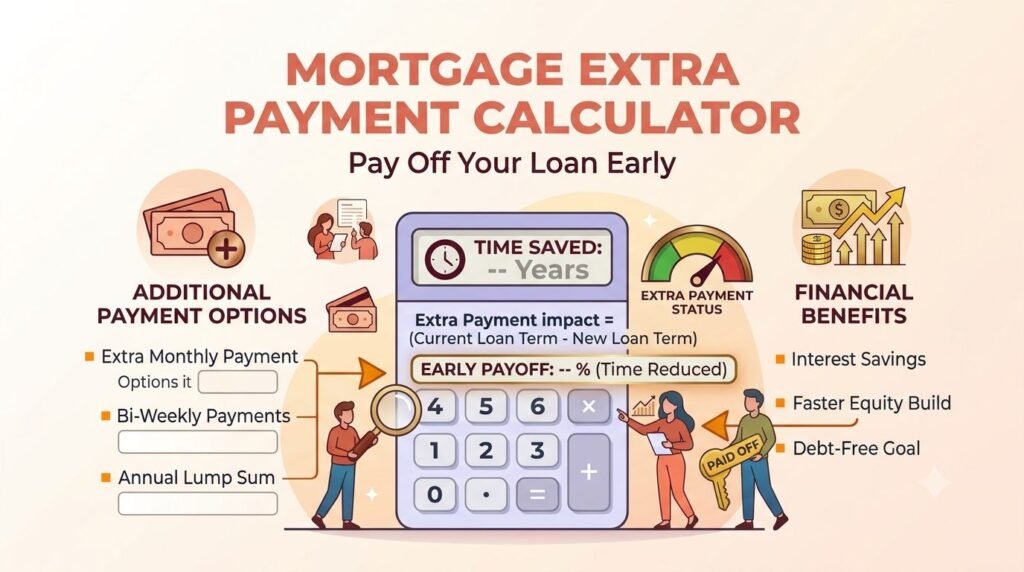
- Extra Payment Amount: The additional cash you plan to put toward your principal. This can be structured as a recurring monthly amount, a yearly lump sum, or a one-time payment.
- Extra Payment Start Date: When you plan to begin making these extra contributions.
With these inputs, the calculator projects two different paths side-by-side: your standard amortization schedule and your accelerated amortization schedule. It immediately calculates your total interest savings and tells you exactly how many months or years sooner your mortgage will be fully paid off.
—
The Math Behind Early Mortgage Payoff (With Formulas)
For those who love to understand the “why” behind the numbers, let\’s look at the actual mathematical formulas used to build mortgage calculators.
1. The Standard Monthly Payment Formula
To find your standard monthly principal and interest payment ($M$), we use the standard amortization formula:
M = P * [ r(1 + r)^n ] / [ (1 + r)^n – 1 ]
Where:
- M = Total monthly principal and interest payment
- P = Principal loan amount (outstanding balance)
- r = Monthly interest rate (annual rate divided by 12 months)
- n = Total number of monthly payments (e.g., 360 payments for a 30-year mortgage)
2. The Monthly Interest Calculation
Every month, your lender determines your interest charge ($I$) using this simple formula:
I = P * r
The remaining portion of your standard payment then goes toward the principal ($PP$):
PP = M – I
3. The Impact of an Extra Principal Payment
When you add an extra payment ($E$), the new ending principal balance ($P_{new}$) for that month is calculated as:
P_{new} = P – PP – E
Because $P_{new}$ is significantly lower than it would be under the standard schedule, the next month\’s interest charge ($I_{next} = P_{new} * r$) drops instantly. This means that even if you didn\’t make another extra payment, more of your regular monthly payment would automatically go toward principal the following month.
—
Step-by-Step Amortization Comparison Table
Let\’s look at a concrete mathematical example. Suppose you have a remaining mortgage balance of $400,000 at a 6.5% interest rate. Your monthly principal and interest payment is $2,528.27.
The table below contrasts the first three months of standard payments against the first three months of making an extra $250 monthly principal payment.
| Month | Standard Principal Paid | Standard Interest Paid | With Extra $250: Principal Paid | With Extra $250: Interest Paid | Interest Savings This Month |
|---|---|---|---|---|---|
| Month 1 | $361.60 | $2,166.67 | $611.60 ($361.60 + $250) | $2,166.67 | $0.00 (First month baseline) |
| Month 2 | $363.56 | $2,164.71 | $614.92 ($364.92 + $250) | $2,163.35 | $1.36 |
| Month 3 | $365.53 | $2,162.74 | $618.25 ($368.25 + $250) | $2,160.02 | $2.72 |
While a few dollars in interest savings may seem modest in months two and three, remember that this effect scales exponentially over 360 months. That single extra $250 payment in Month 1 saves you interest every single month for the next 30 years!
—
3 Real-World Examples of Early Mortgage Payoff Savings
Let\’s explore three common financial scenarios to see how different repayment strategies play out in the long run. For all scenarios, we will use a baseline mortgage of $350,000 at a 6% interest rate with a 30-year term. The standard monthly payment for this loan is $2,098.43, and the total lifetime interest paid under the standard schedule is $405,433.32.
Scenario A: The Small Monthly Addition ($150/Month)
In this scenario, a homeowner reviews their monthly household budget and cuts back on dining out or subscription services to free up an extra $150 per month, applying it directly to their mortgage principal starting in Month 1.
- Standard Monthly Payment: $2,098.43
- New Monthly Payment: $2,248.43
- Time Saved: 3 years and 11 months
- Total Interest Saved: $55,422.18
By sacrificing a small amount of monthly discretionary income, the homeowner saves over $55,000 in pure interest and owns their home outright nearly four years early.
Scenario B: The Annual Lump Sum ($3,000/Year)
In this scenario, a homeowner decides to keep their monthly budget completely unchanged. Instead, they commit to taking $3,000 from their annual work bonus or tax refund and making a single lump-sum extra principal payment every year.
- Annual Lump Sum: $3,000
- Time Saved: 4 years and 9 months
- Total Interest Saved: $68,124.91
Because the lump sum is applied early in the year, it dramatically cuts down the principal balance, leading to massive long-term interest relief without impacting month-to-month cash flow.
Scenario C: The Aggressive Mid-Term Sprint ($500/Month Starting in Year 5)
Many homeowners cannot afford extra payments right after buying a home due to moving costs and furnishing expenses. In this scenario, the homeowner waits five years. After securing a promotion at work, they start contributing an extra $500 monthly toward their principal starting in Year 6.
- Extra Payment Amount: $500/month (starting in Year 6)
- Time Saved: 7 years and 8 months
- Total Interest Saved: $94,510.35
This highlights that it is never too late to start making extra payments. Even starting five years late, an aggressive extra payment strategy can knock nearly eight years off your mortgage term.
—
Different Strategies to Pay Off Your Mortgage Early
There is no one-size-fits-all approach to paying down a home loan. Depending on your career stability, income structure, and financial goals, you can choose from several proven strategies. Use our mortgage extra payment calculator to test each of these methods to find your ideal match:
1. The Monthly Extra Payment Strategy
This is the most popular strategy. You simply add a set amount (e.g., $50, $100, or $500) to your regular payment every month. Lenders make this easy by including an “Additional Principal” line on their online payment portals.
Best for: People with consistent, salaried monthly income who prefer predictable household budgeting.
2. The Bi-Weekly Payment Strategy
Under this strategy, you pay half of your monthly mortgage payment every two weeks instead of one full payment once a month. Because there are 52 weeks in a year, you will make 26 half-payments. This equates to 13 full payments over the course of a calendar year, rather than the standard 12.
Best for: Homeowners who get paid bi-weekly, as it aligns perfectly with their pay cycles. This seamlessly sneaks in an extra annual payment without a painful hit to your monthly budget.
3. The Lump-Sum Strategy
Instead of monthly commitments, you make sporadic, larger payments. These can come from tax refunds, quarterly bonuses, inheritance, or the sale of other assets.
Best for: Freelancers, business owners, or commission-based sales professionals whose income fluctuates significantly throughout the year.
4. The “Dollar-a-Day” Escalation Strategy
If you want to ease into early payoff, try the escalation method. Start by adding $30 a month in Year 1. In Year 2, bump it to $60 a month. In Year 3, bump it to $90. Slowly scaling up your contributions allows your budget to adapt to the savings goals organically.
—
Step-by-Step: How to Use Our Online Calculator
We designed our Mortgage Extra Payment Calculator to be incredibly simple yet highly analytical. Here is how to get the most accurate results in five simple steps:
- Input Your Loan Details: Enter your original or current loan balance, your annual interest rate, and the remaining term of your mortgage in years.
- Establish Your Baseline: Look at the calculated standard monthly payment. Ensure it aligns with your actual bank statement (excluding property taxes and home insurance, as the calculator focuses purely on principal and interest).
- Choose Your Extra Payment Type: Select whether you want to calculate the impact of a Monthly Extra Payment, an Annual Extra Payment, or a One-Time Lump Sum.
- Enter the Amounts and Timing: Put in your planned extra payment amount and specify when you intend to start making these payments.
- Analyze the Results: Review the dynamically generated charts and statistics. Focus on the two most crucial numbers: Total Interest Saved and Years Shaved Off Your Mortgage.
—
Critical Mistakes to Avoid When Making Extra Mortgage Payments
Accelerating your mortgage payoff is a brilliant financial move, but only if executed correctly. Many well-meaning homeowners make critical mistakes that cost them money, trigger unnecessary penalties, or leave them financially vulnerable. Be sure to avoid these pitfalls:
1. Not Specifying “Principal-Only” Payments
If you write a physical check or make an online payment with extra funds without specifying how those funds should be applied, some lenders will automatically apply the extra cash to your next month\’s scheduled payment instead of your principal. This is called “paying ahead” and does absolutely nothing to reduce your lifetime interest or shorten your loan term. Always ensure you select the checkbox or line item clearly labeled “Principal Only” or “Additional Principal”.
2. Neglecting High-Interest Consumer Debt First
Paying off a mortgage early is highly commendable, but it should never take priority over high-interest debts. If you have credit card debt at 20% interest, or personal loans at 12% interest, it makes no mathematical sense to pay extra on a 6% mortgage. Pay off your high-interest debts first before funneling extra cash into your home loan.
3. Ignoring Your Emergency Fund
Once you send extra money to your mortgage lender, that cash is locked inside your home as home equity. You cannot easily get it back if you lose your job or face a medical emergency; you would have to sell the house or take out an expensive home equity line of credit (HELOC). Never make extra mortgage payments until you have at least three to six months of living expenses safely stored in a liquid High-Yield Savings Account (HYSA).
4. Overlooking Prepayment Penalties
While increasingly rare in modern residential mortgages, some older loans or specialty loan programs contain “prepayment penalty” clauses. These clauses charge a fee if you pay off a substantial portion of your mortgage early (usually within the first 3 to 5 years). Before making large lump-sum payments, call your loan servicer or check your original closing disclosure paperwork to verify that your mortgage has no prepayment penalties.
—
The Great Financial Debate: Pay Off the Mortgage Early vs. Invest
One of the most fiercely debated topics in personal finance is whether you should use extra cash to pay off your mortgage early or invest that cash in the stock market instead. Both strategies have incredibly strong merits, and the correct choice depends on a mixture of mathematical reality, interest rates, and personal psychological factors.
Let\’s analyze both sides of the coin:
The Case for Investing (The Mathematical Approach)
Historically, the broad US stock market (represented by the S&P 500) has returned an average of roughly 8% to 10% per year over long periods. If your mortgage interest rate is low (for example, 3% or 4%), the math suggests you should invest your extra money instead of paying down your debt.
By investing, you can capture the spread. For example, if you invest at an 8% return instead of paying down a 3.5% mortgage, you are effectively gaining a net positive return of 4.5% on your capital. Over 30 years, this compound growth in investment accounts can lead to a far larger net worth.
The Case for Early Mortgage Payoff (The Conservative & Psychological Approach)
While investing sounds superior on paper, it carries market risk. Your stock portfolio can go down. Conversely, paying down your mortgage principal provides a guaranteed, risk-free rate of return equal to your mortgage interest rate.
If your mortgage rate is 6.5%, paying it off early is the exact financial equivalent of finding a risk-free investment that guarantees a 6.5% tax-free return. In today\’s market, finding a guaranteed, risk-free 6.5% return is virtually impossible anywhere else.
Furthermore, we cannot discount the massive emotional and psychological relief of owning your home completely free and clear. Knowing that no bank can ever evict you provides an unparalleled level of peace, security, and lifestyle flexibility.
| Feature | Paying Off Mortgage Early | Investing in the Market |
|---|---|---|
| Rate of Return | Guaranteed (equal to mortgage rate) | Variable (historical average 8-10%) |
| Risk Level | Zero risk | Moderate to high market risk |
| Liquidity | Very low (money is tied up in home equity) | High (can sell stocks/funds easily) |
| Tax Implications | May lose mortgage interest tax deduction | Capital gains taxes may apply upon sale |
—
Frequently Asked Questions (FAQs)
Can I make extra payments on an FHA or VA loan?
Yes. By law, federal mortgage programs including FHA loans, VA loans, and USDA loans are strictly prohibited from charging prepayment penalties. You can make extra principal payments at any frequency and in any amount you choose.
How often should I make extra mortgage payments?
Most homeowners find it easiest to make extra payments monthly alongside their standard payment. However, making annual lump sums or bi-weekly payments works equally well. The key is consistency; the sooner you get the money to the lender, the sooner it stops compounding interest.
Does paying extra principal lower my monthly payment next month?
No. Making extra principal payments does not lower your future required monthly payments. Your monthly obligation remains exactly the same. Instead, what changes is that your mortgage balance will hit zero years ahead of schedule, completely eliminating the final years of your payment calendar.
What is a mortgage recast, and how does it differ from extra payments?
When you make massive extra payments, you can request a “mortgage recast” from your lender. During a recast, your lender takes your newly reduced principal balance and recalculates (amortizes) your remaining payments over the original timeline of the loan. This keeps your early payoff date the same as originally planned but instantly lowers your required monthly payment, boosting your monthly cash flow.
Is it better to refinance or make extra payments?
Refinancing is ideal when current market interest rates are significantly lower than your original mortgage rate. However, refinancing incurs closing costs (usually 2% to 5% of the loan amount). Making extra payments is completely free, carries no closing costs, and achieves a similar interest reduction effect.
Will making extra payments hurt my credit score?
No, paying off your mortgage early will not harm your credit score in the long run. When you fully pay off your mortgage, your credit score might experience a temporary minor dip of a few points because an active account is closed. However, your credit health will remain robust, and your debt-to-income (DTI) ratio will improve dramatically, which is highly favorable to future lenders.
—
Pro-Tips for Accelerating Your Journey to Financial Freedom
- Automate Your Savings: Treat your extra mortgage payment as a non-negotiable bill. Set up an automatic monthly transfer on your bank account so you do not have to think about it.
- Round Up Your Payments: If your monthly mortgage payment is $1,830, round it up to $1,900 or $2,000. It is a painless mental trick that naturally chips away at your principal over time.
- Keep Your Bank Statements: Always review your monthly statements to confirm your extra payments are accurately categorized as “Principal Balance Reductions.” Keep paper or digital records of these transactions just in case any discrepancies arise with your lender.
Take Control of Your Financial Future Today
Mortgage interest is a silent drain on long-term wealth accumulation. While paying down a mortgage early requires discipline and short-term sacrifices, the long-term payoff is nothing short of life-changing. By using our Mortgage Extra Payment Calculator, you can stop guessing and start calculating. Drag the sliders, plug in your numbers, and watch as small, manageable adjustments transform your financial future. Run your calculations today, build your custom payoff blueprint, and take the first step toward a debt-free life!