Your credit card arrives with a spending limit $2,000, $5,000, maybe $10,000. But who decided that number, and why did your friend get double? Your credit limit isn’t random. Banks run your financial profile through a specific set of checks, and understanding them is the fastest way to get a higher limit.
This guide breaks down exactly how banks decide your credit card limit, the 7 factors that matter most, and the proven steps to increase it.
What Is a Credit Card Limit?
Your credit card limit is the maximum amount your bank lets you borrow on the card. Spend up to it, and every payment you make frees up that amount again (this is called revolving credit). Go over it and you’ll face declined transactions, over-limit fees, and potential damage to your credit score.
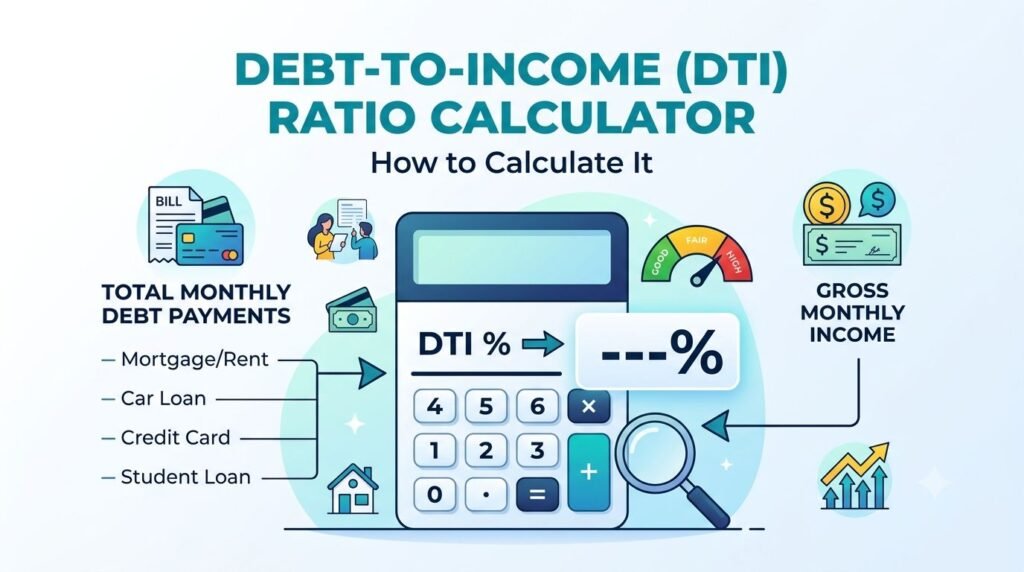
Check your numbers: Use our free Credit Limit Calculator to find your ideal limit based on your monthly spending and the 30% rule. Also explore our Debt-to-Income Ratio Calculator to see where you stand before requesting an increase.
The 7 Factors Banks Check Before Setting Your Limit
1. Your income. The single biggest factor. Banks typically set limits as a multiple of your monthly or annual income — higher verified income means a higher starting limit.
2. Your credit score. A strong score (750+) signals you repay reliably. Banks reward that with bigger limits; a weak score means a cautious, low limit.
3. Your credit history length. A 10-year track record of on-time payments beats a 10-month one. Longer history = more trust = higher limit.
4. Existing debts. Banks look at your debt-to-income ratio. If you’re already servicing large loans, they won’t add much more exposure.
5. Employment stability. Salaried employees with steady jobs get better limits than applicants with irregular or unverifiable income.
6. Your relationship with the bank. Existing customers with salary accounts, deposits, or investments at the same bank often get preferential limits.
7. The card tier itself. Every card product has a floor and ceiling — a basic card might max out at $3,000 while a premium card starts at $10,000.
Credit Utilization: The 30% Rule
Here’s the number that matters most day-to-day: keep your spending under 30% of your limit. Spend $900 on a $3,000 limit and you’re at 30% — the threshold banks and credit bureaus watch.
Why? High utilization signals financial stress, and it can drag your credit score down even if you pay in full every month. Someone spending $2,700 of a $3,000 limit looks risky; the same $2,700 on a $10,000 limit looks comfortable.
Worked example: With a $5,000 limit, keep monthly spending under $1,500 for the healthiest score impact. Want to spend $3,000 monthly? You’d want at least a $10,000 limit to stay at 30%.
How to Increase Your Credit Card Limit
1. Just ask. After 6–12 months of on-time payments, call your bank or use the app’s “request limit increase” option. Banks grant these routinely to good customers.
2. Show higher income. Got a raise or a new job? Update your income details with the bank — it’s the fastest trigger for a limit review.
3. Keep utilization low. Months of sub-30% usage prove you handle credit responsibly — exactly what banks want to see before raising limits.
4. Pay on time, every time. A single missed payment can freeze increases for a year. Automate at least the minimum payment.
5. Don’t apply for 5 cards at once. Multiple hard inquiries in a short period signal desperation and can lower your score.
6. Upgrade your card. If your spending has outgrown a basic card, ask for a product upgrade — higher tiers carry higher limits by design.
Important: A higher limit only helps if your spending stays the same. If you treat it as permission to spend more, you’ll end up deeper in debt with the same utilization problem.
Frequently Asked Questions
Does requesting a limit increase hurt my credit score?
Sometimes the bank does a hard inquiry, which can dip your score a few points temporarily. Many banks now do soft checks for existing customers — ask before you request.
How often can I request an increase?
Most banks allow a review every 6 months. Requesting too frequently looks needy and gets declined.
Will a higher limit automatically improve my score?
It lowers your utilization ratio, which helps — but only if your spending doesn’t rise to match it.
Why was my increase request declined?
Usually: short account history, recent missed payments, high existing debt, or no income change since the last review. Wait 6 months and try again.
Is there a maximum credit limit?
Each card product has a ceiling, and banks cap total exposure across all your cards based on income. There’s no universal maximum.
Disclaimer: This article is for educational purposes only and is not financial advice. Card policies vary by bank and country.